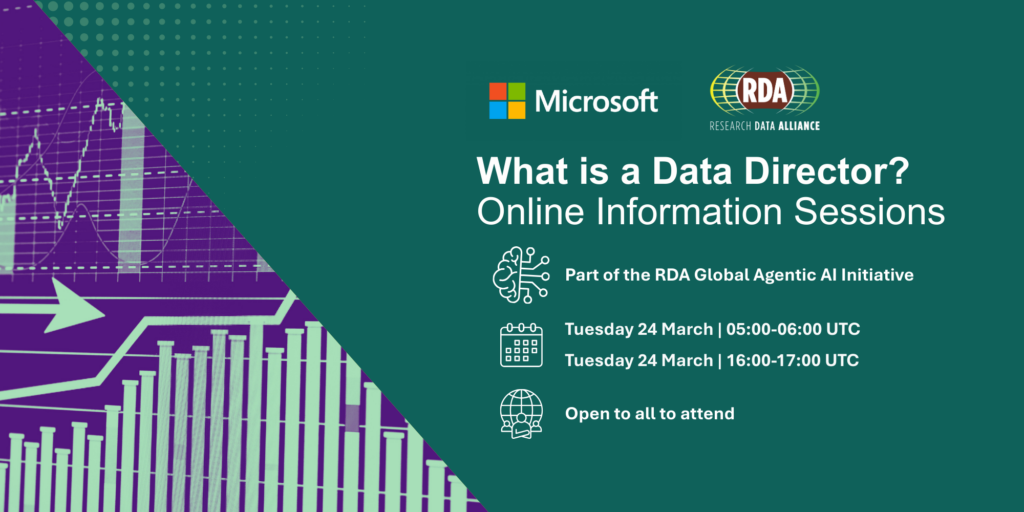
What is a Data Director, and how can it augment research data management practice? Ranked as the second most useful agentic AI tool in a global community consultation organised by RDA and Microsoft, a Data Director has emerged as a priority tool for the research data community.
Participants joined us for a 1-hour online information session designed to inform and inspire the global research data community. This session took a deeper dive into a Data Director, exploring its features and functionalities, and how to begin developing an agentic AI blueprint for such a tool. There was space for open discussion on the opportunities and challenges ahead, as well as suggestions for improvement.
Session Recording and Presentation Slides
Discussion Summary
Does the Data Director Address a Real Problem?
Attendees broadly agreed the Data Director would be a useful tool. One concern was raised about the risk of errors spreading through automated data infrastructure, including a tendency for AI agents to try creative workarounds rather than stopping to question their own approach.
What Should the Data Director Do?
The session started from three core features, generating FAIR-compliant metadata, supporting DOI workflows, and recommending data repositories, and the community quickly added to this. Suggestions included helping researchers find and connect related datasets, recommending appropriate data formats and standards, auto-generating draft Data Management Plans (DMPs), producing data documentation such as README files, and providing a FAIR completeness score to track progress over time.
Background
This initiative built on the Global Community Consultation on Agentic AI in Research, which identified three priority agentic AI tools for the research community (1. Literature Librarian, 2. Data Director; and 3. Funding Finder). These information sessions marked the next step in that journey: equipping the community with the knowledge to contribute to the upcoming blueprint development for an open, technology-agnostic, priority AI agent.
All outputs from this work follow the RDA framework and guiding principles and will be openly available for adoption and reuse.
Online Sessions
Two sessions were available to accommodate different time zones:
📆 Session 1: Tuesday 24 March, 05:00-06:00 UTC
📆 Session 2: Tuesday 24 March, 16:00-17:00 UTC
Agenda
| Time (UTC) | Item | Lead |
|---|---|---|
| 05:00-05:10 | Welcome and Introduction | Connie Clare (RDA) |
| 05:10-05:20 | What is a Data Director? | Connie Clare (RDA) |
| 05:20-05:30 | What is a Blueprint? | Software Engineer (Microsoft) |
| 05:30-05:55 | Q&A (20 mins) | All |
| 05:55-06:00 | Closing remarks | Connie Clare (RDA) |
What was covered?
- What a Data Director could do and how it could augment research data management through FAIR-compliant data preparation and sharing.
- Why a Data Director was ranked the second most useful agentic AI tool in the RDA and Microsoft global community consultation, and what that means for the research data community.
- How to begin developing an agentic AI blueprint for a Data Director, including its key features and functionalities, and the opportunities and challenges of bringing such a tool to life.
Getting Involved
These sessions were open to all and free to attend. Whether new to the topic or already exploring agentic AI in work, this was an opportunity to learn, ask questions, and help shape the future direction of this community-driven initiative.
For questions or comments, please contact RDA Community Development Manager, Connie Clare ([email protected]).
What is a Funding Finder?
Join us for a 1-hour online information session designed to inform and inspire the global research data community. This session will take a deeper dive into a Funding Finder, exploring its features and functionalities, and how to begin developing an agentic AI blueprint for such a tool. There will also be space for open discussion on the opportunities and challenges ahead, as well as suggestions for improvement.