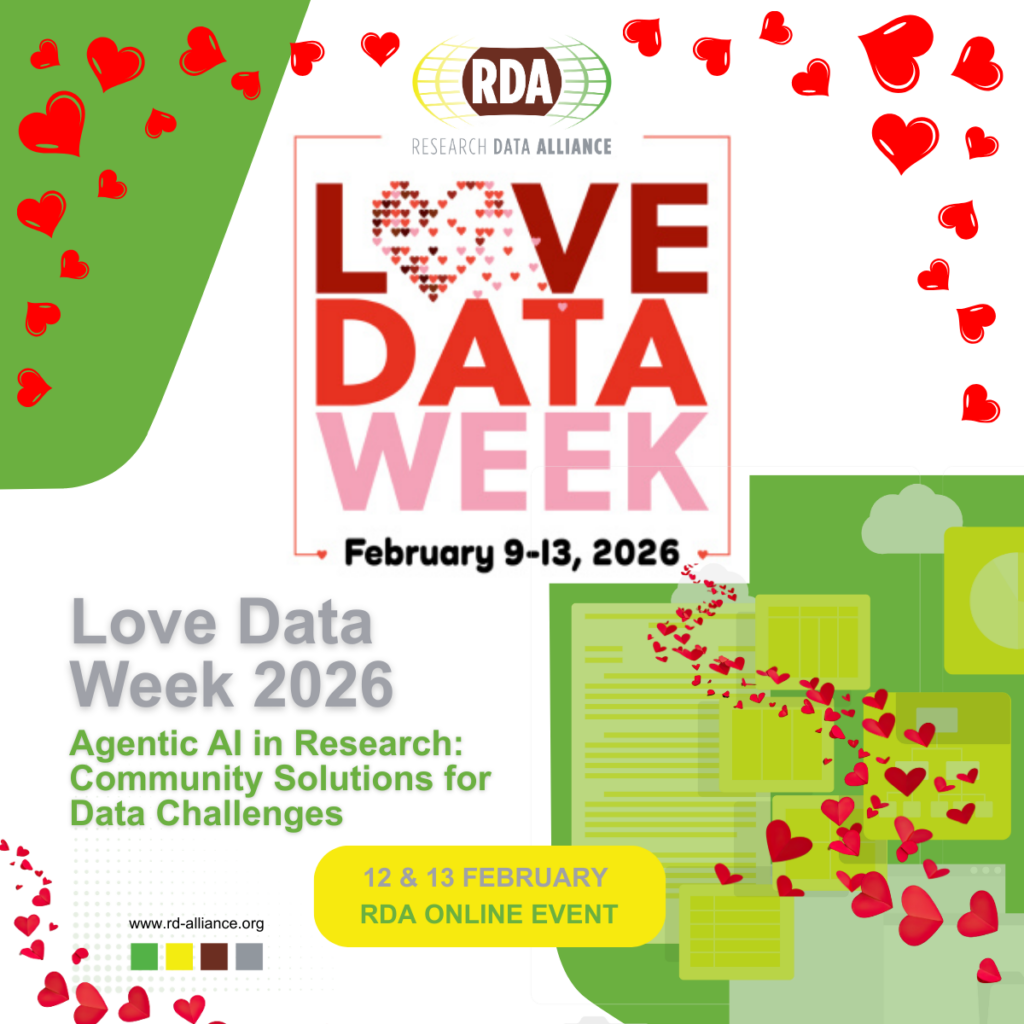
As part of Love Data Week 2026, the Research Data Alliance (RDA) hosted two webinars, bringing more than 130 international participants together, to explore questions around Artificial Intelligence (AI), particularly Agentic AI, and its potential role in research workflows and data management practices.
In these 45-minute sessions, we shared insights from our recent global community consultation on agentic AI in research and discussed both the opportunities and challenges these emerging technologies present for the research lifecycle.
What was covered?
- How the RDA community develops consensus-driven recommendations and outputs for data infrastructure
- Recent RDA initiatives on artificial intelligence, including the State of AI workshops and RDA-Microsoft roundtables on data readiness
- Key findings from our global community consultation on agentic AI – where researchers identify both opportunities and significant concerns
- The top-priority agentic AI tools proposed by the research community, from Literature Librarians to Data Directors
- Critical questions about accuracy, transparency, and whether these tools can appropriately support research data management
- Community concerns about maintaining research skills, data quality, and essential human oversight
- Opportunities to contribute to ongoing community discussions and help shape responsible approaches to AI in research
Whether you were a researcher, data professional, or institutional stakeholder curious about the evolving relationship between AI and data management, these sessions provided balanced perspectives from the research community on navigating these complex questions.
Two 45min session were held to accommodate global participants:
- February 12, 2026 at 16:00 UTC
- February 13, 2026 at 02:00 UTC
Recordings, Slides and Q&A Summary
The Q&A explored whether agentic AI requires human-in-the-loop oversight. A participant building agentic systems for UN translation work emphasised that human oversight remains essential, as agentic systems frequently produce errors and require precise logging to trace where things go wrong. The Croissant for Machine Learning standard was highlighted as one approach to logging each step for accountability.
Participants discussed what distinguishes agentic AI from standard LLMs, with one contributor explaining that agentic AI’s value lies in its autonomy to explore unknown data spaces over time and make its own decisions. Questions were also raised about data security and tool evaluation, which speakers noted would need to be addressed collaboratively during the blueprint development phase. A university representative shared that while general AI tools like Google Gemini are useful for day-to-day productivity, specialist tools for specific parts of the research workflow are likely still needed.
Participants also discussed opportunities to participate in future RDA AI-related groups, including the Computational Modelling of Health Data WG (not yet endorsed) and Documenting LLM Interactions throughout the Research Data lifecycle (P25 BoF).
Resources Shared
Part of Love Data Week 2026
Aligned with the 2026 theme, ‘Where’s the Data?’, the RDA community discussed whether and how agentic AI tools might support data quality and research data management, from automated metadata creation to FAIR principles compliance, while carefully considering the risks, limitations, and the irreplaceable role of human expertise and oversight throughout the research lifecycle.