
Adopting the Global Open Research Commons (GORC) Model – REASON Project

Adoption Factsheet
Outputs Adopted: Global Open Research Commons (GORC) International Model
Related RDA Groups: GORC International Model WG
Adopting Organisation: REASON Project (ResEArch CommonS fOr Norway)
The RDA Output adopted
The Global Open Research Commons (GORC) International Model is a framework designed to facilitate the development of interoperable research commons, promoting open and accessible research for the public good. It provides a common language and structure for stakeholders involved in research commons development, offering guidance on essential elements, attributes, and key performance indicators. The model is not prescriptive but rather aims to establish a foundation for building and connecting research commons globally.
This Adoption Story was created with the support of the RDA TIGER project.

What was the challenge that you addressed?
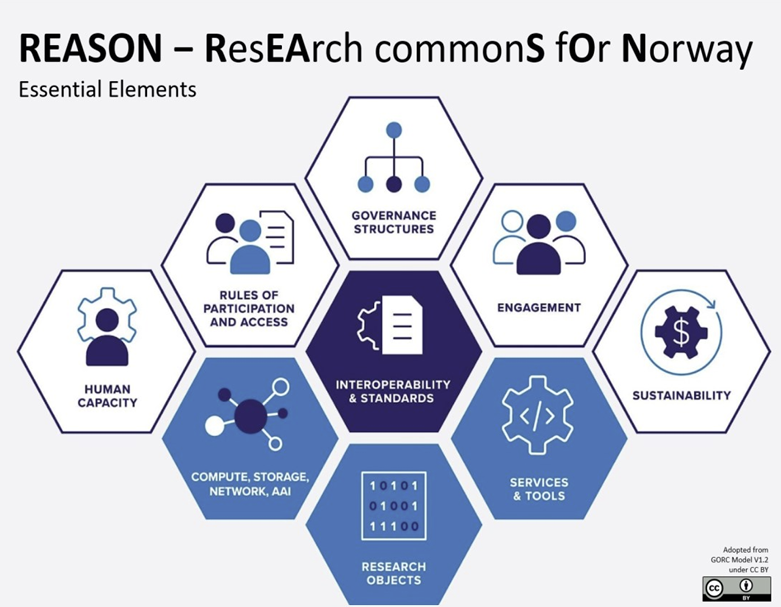
The GORC International Model was used as a conceptual framework to align our national infrastructure proposal with internationally recognized standards and recommendations. This helped ensure that our approach to interoperability and research infrastructure was not just locally defined but globally validated. The model’s credibility, stemming from being developed by an open, community-driven RDA Working Group, gave our proposal to the Research Council of Norway a form of international endorsement. Additionally, the GORC model’s comprehensive structure, covering both technical aspects like services and tools, and broader elements like governance and human resources, helped us build a well-rounded, holistic proposal.
The adoption process
The adoption process involved figuring out how to use the GORC model to shape a coherent and practical plan for establishing a research infrastructure. While the model offers useful guidance through its nine core elements, it doesn’t provide specific implementation steps (this was outside the scope of the original GORC International Model WG, but has been picked up by the follow-on GORC International Implementations WG). The main challenge was translating the reference framework into a concrete, fundable plan—deciding priorities, allocating responsibilities among partners, and determining how to address elements like human capacity within budget constraints. Ultimately, the REASON team had to interpret and adapt the model to create a functional, real-world infrastructure.
Benefits and impact of adoption
The main benefit of the GORC International Model was having a comprehensive reference framework to guide the development of a research infrastructure. Unlike fragmented recommendations from other sources, GORC offered a holistic approach, helping the team avoid the extra work of building a framework from scratch. Its nine core elements served as a useful checklist, ensuring all key areas were addressed in the proposal. However, the model acted more as a partial template. It provided direction but lacked detailed guidance on how to implement each element. This meant the team had to develop much of the content themselves, especially for complex areas like services and tools. Being early adopters, we had to contribute new thinking beyond what the model offered.
What lessons did you learn?
A major lesson learned was that while the GORC model provides a strong, top-down framework, it’s essential to also demonstrate how each element of the model responds to the specific needs of the community being served. The model exists independently of local context, but implementation is shaped entirely by the environment – political, institutional, and organizational. In this case, this included Norwegian universities, national infrastructure players, and funders with their own agendas, all of which heavily influenced how the GORC model could be applied.
About the Adopter(s)
REASON Project
The REASON (ResEArch CommonS fOr Norway) project aimed to establish a national research infrastructure for Norway, building upon the Global Open Research Commons (GORC) International Model. This infrastructure was intended to integrate and enhance existing, yet often fragmented, research data components used by researchers in Norway, including domain-specific resources, in order to create a comprehensive research commons. The project was a response to the growing need for accessible, interconnected research data to support various disciplines and foster collaboration.
Other Adoption Stories


